
CS: Legacy 2026 Update: The 1.6 Source Remake vs. Valve Legal Issues
Last updated: April 9, 2026
CS: Legacy: Source Remake, Valve’s Legal Stance
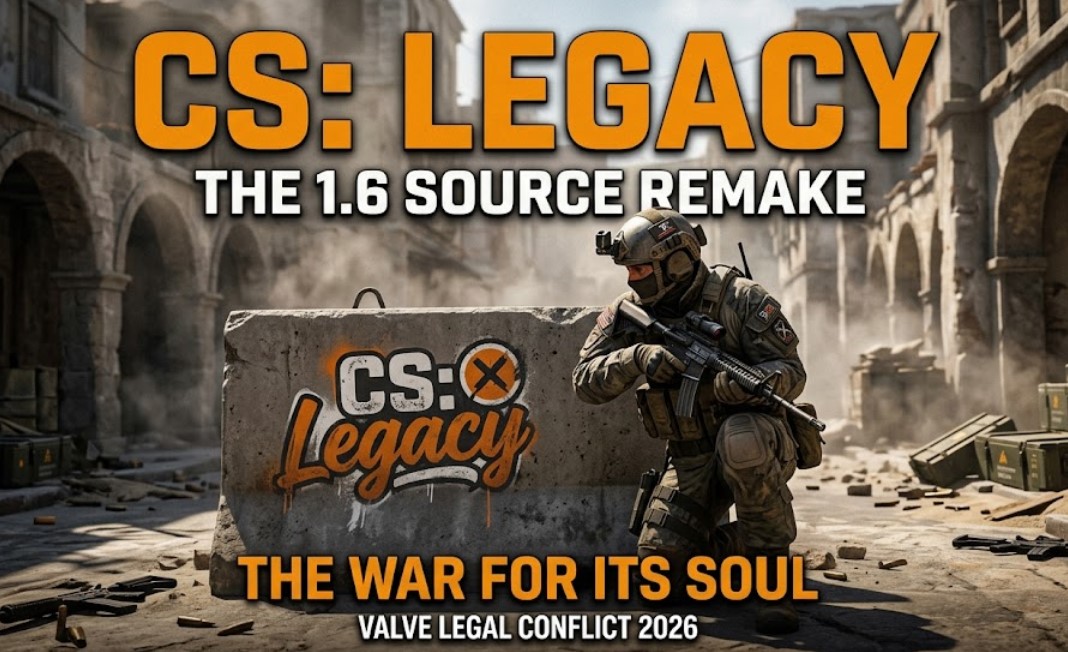
The CS: Legacy project, spearheaded by the Midnight Madness team (the veteran developers behind the legendary CSPromod), has reached a definitive turning point.
This isn’t just another mod; it is a ground-up attempt to save the 1.6 soul by creating a high-performance CS 1.6 Source port on a modern architecture.
They are trying to fix what “official” versions broke: the movement, the netcode, and the raw competitive integrity.
However, as of March 2026, the project has hit a massive legal and technical wall. This is the reality of trying to preserve a “legacy” experience in an era where Valve is tightening its grip on intellectual property to protect the CS2 ecosystem.
The Valve Shutdown Threat: March 2026 Timeline
The “honeymoon phase” for CS: Legacy ended abruptly in early March 2026. For months, the developers operated in a gray area, assuming that as long as they didn’t charge for the game and used the Source SDK 2013, they were safe. They were wrong. The legal pressure didn’t come as a sudden ban, but as a suffocating series of demands that have put the project’s future on Source in jeopardy.
The “Notice of Concern” and Trademark Infringement
Valve’s legal team issued a formal notice targeting the use of the “Counter-Strike” name and the specific replication of iconic layouts that are inextricably linked to the brand. In 2026, Valve has significantly tightened its policy for fan creations that directly copy their old intellectual property, regardless of the engine used. The irony is that while CS: Legacy uses the official SDK, Valve views it as a “hostile fork”—a version of their game that they don’t control and can’t monetize. They fear it will fragment a user base they’ve worked hard to force into CS2.
The Patreon and Commercialization Trap
One of the most contentious points is the project’s funding. The Midnight Madness team uses Patreon to cover the costs of high-end asset creation and dedicated testing servers. Historically, Valve has ignored small mods, but once a project generates thousands of dollars in monthly “donations,” it crosses the line from a hobby to a “commercial enterprise” in the eyes of corporate law. Internally, the team argues that without these funds, the level of PBR (Physically Based Rendering) detail—essential for making a 20-year-old game look modern—would be impossible to achieve. Valve, however, sees it as profiting off their back catalog.
Brand Dilution and CS2 Competition
Valve has invested millions into the sub-tick system and the skin economy of CS2. If a fan project like CS: Legacy offers a cleaner, more skill-based experience without modern monetization, it poses a perceived threat to the active player count of CS2. Valve cannot allow a fragmented community where the “purists” leave the main platform for a fan-made alternative that doesn’t sell cases. They are protecting their bottom line, even if it means killing the very community spirit that built the franchise.
Plan B: The Godot Engine and “The Spiritual Successor”
The developers at Midnight Madness aren’t going down without a fight. They have already announced a contingency plan if the project is permanently shut down on the Source engine: The Great Migration to Godot.
If forced to abandon the Valve ecosystem, the team will transition to the Godot Engine. This is a strategic move that fundamentally changes the future of the project from a “mod” to a “standalone game.” It is a declaration of independence.
A New Identity: “Legacy Tactical”
The game would no longer be called “Counter-Strike.” It would adopt a name like Legacy Tactical or Madness 1.6. While losing the brand is a blow to marketing, it grants the developers total creative freedom. They are already planning a “90s Action Film” aesthetic—focusing on high-contrast lighting and gritty environments that move away from the official “clean” Valve look. Think of it as the John Wick of tactical shooters—brutal, precise, and visually striking. They aren’t just making a clone; they are making the game 1.6 should have evolved into.
Full Engine Control and Physics
By moving to Godot, an open-source engine, the developers gain:
- Full Engine Control: They can rewrite the networking stack from scratch to ensure zero-latency hit registration, bypassing the limitations of the aging Source engine. No more “dying behind walls” or sub-tick inconsistencies.
- Security: They can permanently eliminate the Server-side Command Injection and CS 1.6 SlowHack vulnerabilities that plague the old GoldSource engine. It will be the most secure way to play classic tactical FPS.
- Physics Integrity: This is the most critical part. The team has already successfully “mathematically ported” the 1.6 movement. This means the strafe-jumping, duck-hopping, and specific air-accelerate values will feel 100% identical, even if the underlying code is completely new. The “feel” of 1.6 is safe.
The State of the Content: What Has Been Built?
Despite the legal drama, the sheer amount of work completed in the latest beta version is staggering. To avoid being shut down for “asset flipping,” the team has created every model and texture from scratch. This isn’t just a reskin; it’s a meticulous reconstruction of a masterpiece.
The Maps: A Masterclass in PBR
Using Physically Based Rendering (PBR), the team has re-imagined the classic map pool with modern visuals that don’t use any original Valve code.
- de_dust2: High-contrast environment that feels like a real warzone. The textures actually react to light, creating a depth the original 1.6 never had while maintaining the “clean” angles competitive players demand.
- de_nuke: Focused on industrial realism with realistic metal reflections. The “Upper” and “Lower” bomb sites have been acoustically tuned to reflect the 1.6 sound-positioning logic, solving the vertical audio mess found in CS:GO and CS2.
- de_train: Meticulously measured to ensure that every original 1.6 smoke and flash spot works perfectly. The trains themselves are modeled with realistic weathering, looking like heavy machinery rather than painted boxes.
- cs_poolday & aim_map: These aren’t just for fun anymore; they serve as tech demos for high-refresh-rate optimization, reaching over 1000 FPS on modern hardware. It’s about raw performance.
Custom Models and Assets
To avoid DMCA strikes, the weapons and player models are not direct copies. They are high-fidelity, original creations that pay homage to the classics. The AK-47, M4A1, and AWP have been rebuilt with original animations that are synchronized frame-by-frame with the original 1.6 timing. This ensures that the “rhythm” of the game, the time it takes to pull out a grenade or reload—remains untouched. It’s 1.6 muscle memory in a 2026 shell.
Why This CS: Legacy Project is Dangerous for Valve
The real reason for the tension in 2026 isn’t just “stolen maps.” It’s about player autonomy and, more importantly, direct financial threat.
Valve’s current business model for Counter-Strike 2 is built entirely around the Steam Market and skin economy. CS2 is essentially a platform for virtual asset trading, where every transaction generates a fee for Valve. CS: Legacy is a direct threat to this profit machine. By offering a world-class competitive experience without loot boxes, keys, or $500 skins, Midnight Madness is creating an “exit ramp” for the most dedicated players. Valve cannot afford a competitor that proves players would rather play for a high score and skill progression than for a rare knife skin.
Technical Superiority and the “CS2 Replacement” Fear
In private testing, CS: Legacy has shown significantly lower input latency and better hit registration than CS2’s controversial sub-tick system. This technical superiority is a PR nightmare for Valve. If a small fan team can build a more responsive game on an open-source engine than a multi-billion dollar corporation can on Source 2, it exposes the “bloat” and misplaced priorities of modern AAA development. Valve is using legal pressure to suppress a competitor that is simply better at being a tactical shooter.
The Future of CS: Legacy: A Uncertain Road Ahead
The project is currently in a state of absolute flux, and we have to be honest: the chances of seeing CS: Legacy on the official Steam storefront anytime soon are slim to none. Valve has built a walled garden around the Counter-Strike brand, and they aren’t about to let a fan-made powerhouse tear it down. We might be looking at a project that never technically “releases” in the traditional sense.
Instead of a grand Steam debut, the Midnight Madness team may be forced to take a darker, more independent path. We are looking at a high probability that this will remain a private, community-driven project, distributed through alternative platforms or direct “underground” launchers to bypass Valve’s legal reach. There is even talk of the project operating as a closed-invite beta indefinitely, a way to keep the game alive for the purists while staying just under the corporate radar.
However, everything right now is speculation. The truth is, nobody, perhaps not even the developers themselves, knows exactly how this ends. We are watching a game of cat and mouse where the stakes are the very survival of 1.6’s mechanical soul. Whether it survives as a heavily guarded Source mod or evolves into an independent title on Godot, one thing is certain: the demand for a modernized 1.6 experience is massive, and it is being completely ignored by the mainstream industry.
While Valve might try to kill the name to protect their bottom line, they cannot kill the math behind the movement or the passion of the players who are tired of “Live Service” gaming and gambling-centric ecosystems. The project is a symbol of defiance.
For those who don’t want to wait for a “maybe” and still prefer the original, un-modded cs 1.6 experience without the lag and scams, you can always find a clean, protected version at csdownload.net. We will continue to monitor the situation as the battle between fan-innovation and corporate-control continues.
This is more than just a mod; it’s a fight for the future of tactical FPS, and right now, the outcome is anyone’s guess.
To download the original game files or check out our main Counter-Strike 1.6 hub, feel free to use our links. If you want to play like a professional.