
Why Is the CT Shield Banned in CS 1.6 – Real Reasons
Last updated: May 9, 2026
The CT Shield in CS 1.6 – officially called the Tactical Shield – costs $2200 and gives Counter-Terrorists a deployable ballistic shield while limiting them to a pistol. It was ported from Gearbox’s Condition Zero build and never appeared in CS:Source or any later title. On virtually every public Counter-Strike 1.6 server today the tactical shield is banned or restricted. This page explains exactly why – from the mechanical problems to the social dynamic that made the CS 1.6 shield ban the universal default.
Table of Contents
- The balance problem – CT only with no counter
- How the shield kills round pacing
- Technical bugs and hitbox issues
- Competitive CS 1.6 never allowed it
- Why the CS 1.6 shield ban spread to almost every server
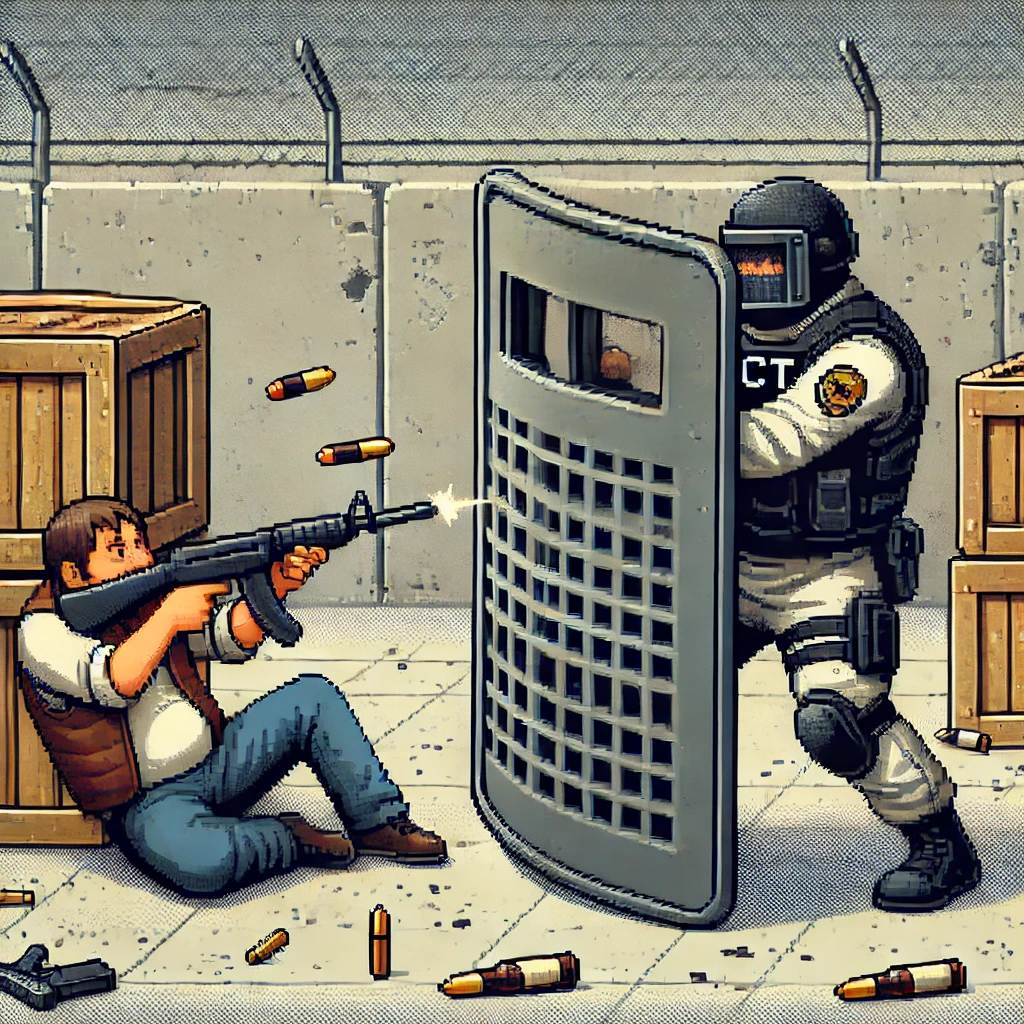
The balance problem – CS 1.6 CT shield is CT-only with no counter
Counter-Strike 1.6 is built around symmetric weapon balance. Every powerful tool available to one side has a meaningful counter on the other. The tactical shield in CS 1.6 breaks this completely:
| CT weapon | T counter |
|---|---|
| M4A1 – accurate suppressed rifle | AK-47 – higher damage, one-shot headshot |
| AWP – one-shot long range | Scout – mobile alternative, same one-shot capability |
| SG-552 – scoped CT rifle | AK-47, G3SG1 |
| Tactical Shield – blocks all frontal bullet damage | Nothing. Terrorists have no equivalent. |
Against a deployed CT Shield, Terrorist options are severely limited. Shooting the front is useless. Grenades can work if they land directly behind the shield or at the feet, but the explosion geometry is inconsistent. Flanking requires the Terrorist to break cover. The knife requires closing to melee range while under pistol fire. A shield user who plays defensively and does not make positioning mistakes is extremely difficult to remove without perfect team coordination – and on a public server, that coordination rarely exists.
The shield user is also trading a rifle for a pistol, which is a real cost. But on a site defense or narrow corridor hold, the pistol is sufficient and the shield negates any return damage. The trade is not symmetric for both teams.
How the CS 1.6 shield slows down round pacing
CS 1.6 rounds have a natural rhythm: entry frags, site take, plant or save, retake. The shield disrupts this rhythm at every stage. A shield user camping a chokepoint or door forces Terrorists to either waste time finding a flank, use utility they may not have, or sacrifice a player to break the hold. Rounds that should resolve in 30-45 seconds drag to 90 seconds or longer.
The problem extends to the CT side as well. Shield users frequently block doorways and narrow corridors, preventing teammates from repositioning. On maps like de_dust2 or de_inferno where chokepoints are critical, a shield user standing in a doorway blocks two or three teammates behind them. CT teammates who need to rotate cannot pass. This generates friction within the CT team that has nothing to do with the Terrorists.
Server owners running public servers measure success by how long players stay and whether they return. Rounds that go long and frustrate both teams drive players off the server. The shield creates that frustration reliably enough that removing it became the obvious administrative choice.
Technical bugs – CS 1.6 shield hitbox problems
The CS 1.6 tactical shield has known technical problems that were never patched. The shield hitbox does not always match the visible shield model. Bullets from specific angles, particularly low shots aimed at the feet and shots from elevated positions, sometimes pass through the visual shield and register on the player body. This is inconsistent: the same shot from the same angle does not always produce the same result.
Grenade interactions are similarly unreliable. A flashbang or HE thrown to land just behind the shield sometimes detonates in front of it, sometimes clips through the shield model and detonates behind it, and sometimes reflects off at an unexpected angle. Players cannot reliably predict the outcome, which makes grenades a poor counter in practice even when positioned correctly.
Some server administrators also reported increased server-side lag when multiple shield users were active simultaneously. The shield collision processing in GoldSrc is not optimized for multiple active shield entities, and on servers already running near capacity this contributed to noticeable performance drops.
Why the CS 1.6 shield was never used in competitive play
The Tactical Shield in Counter-Strike 1.6 was never legal in organized competition. ESEA, ESL, and every other competitive league that ran CS 1.6 tournaments restricted the shield from the start. No professional CS 1.6 player built any strategy around it. The competitive community’s complete rejection of the shield sent a clear signal to the broader player base: this is not a legitimate tool, it is a pub mechanic for casual chaos.
When players who had experience with competitive settings joined public servers and saw the shield in use, they brought that competitive perspective with them. The attitude that “the shield is not real CS” spread from the competitive community outward and became the dominant opinion on most servers within a few years of the shield’s introduction.
Why the CS 1.6 shield ban spread to almost every server
The mechanical and technical reasons above are real, but they are not the primary reason the shield is banned on CS 1.6 servers today. The primary reason is simpler: players complained loudly and persistently until server owners gave in, and once enough servers banned the CS 1.6 shield, the ban became the expected default.
The pattern on almost every server followed the same sequence. A player uses the shield. Other players in chat immediately start complaining – “ban shield,” “remove shield,” “shield players are trash,” “shield is for noobs.” If the shield user wins a round with it, the complaints escalate. Players threaten to leave or disconnect. The server admin or owner, who is usually also a player on the server and wants to keep their community happy, adds the shield to the restricted weapon list. Problem solved, players stop complaining.
This happened on enough servers that the ban became the community norm. New server owners setting up a CS 1.6 server in 2015, 2018, or 2022 would look at existing servers for configuration reference and see the shield universally restricted. They would restrict it too, not necessarily because they had experienced the shield problem themselves, but because “everyone bans the shield” had become accepted community knowledge. The social pressure created a self-reinforcing standard that spread the ban far beyond the servers where it was originally motivated by actual gameplay complaints.
The AlliedModders community developed a dedicated “No Shield” AMXX plugin specifically because demand from server owners was high enough to warrant it. The plugin’s existence and widespread adoption further normalized the ban – having a simple one-line solution made restricting the shield trivially easy for any server admin.
If you run a CS 1.6 server and want to manage weapon restrictions or other server-side settings, see the admin commands guide.
For additional files and configs, check the main Counter-Strike 1.6 page and download the original CS 1.6 installer.