
CS 1.6 Radio Commands on Public Servers – Why No One Listens
Last updated: September 29, 2026
You press the radio command button, “Go go go!” plays, it shows up in chat – and nothing happens. Your teammates keep doing whatever they were already doing. If you have played on a CS 1.6 public server for more than ten minutes you know this feeling. The radio command system works fine technically. The problem is everything around it.
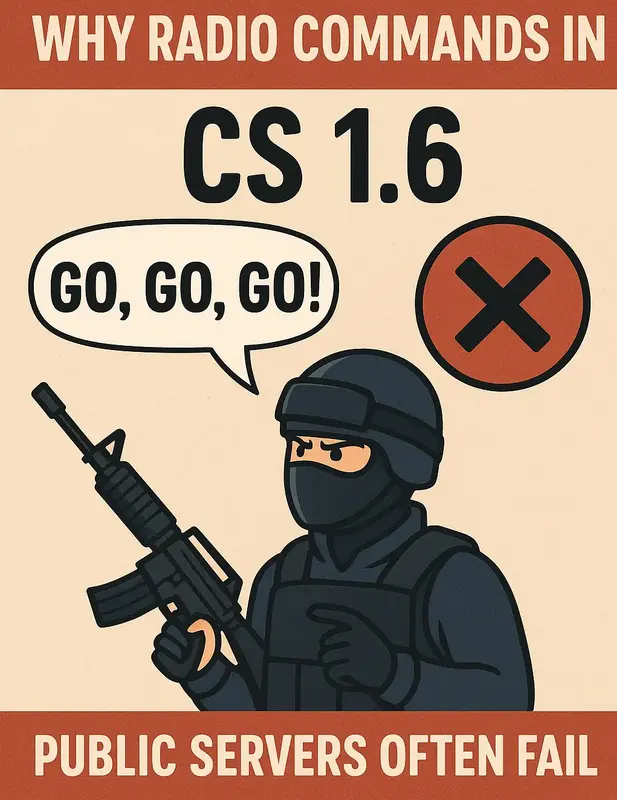
Most players on public servers are new to CS 1.6
Counter-Strike 1.6 has been around for over 20 years but people still discover it every day. Many players on any given public server are relatively new to the game. They are still figuring out basic movement, how to buy weapons, where the bombsites are. When “Go go go!” appears in chat they might not know what it means in context, which direction to go, or even that it came from a teammate and not the server.
Radio commands assume a baseline of game knowledge – map awareness, round timing, role awareness. New players do not have that yet. So the command lands and nothing connects. It is not that they are ignoring you. They just genuinely do not know what the expected response is.
Half the server plays without sound
A significant portion of players on any public counter-strike 1.6 server play with sound off or very low. No headphones, speakers turned down, playing in a place where they cannot have audio. For these players the radio command audio clip plays to nobody. The only thing they see is a line of chat text that scrolls past in a second alongside kill notifications, server messages, and other chat.
Even players with sound on might not notice. On a busy server the audio mix is constant – gunfire, footsteps, grenades, voice chat, other radio commands stacking on top of each other. One “Cover me!” audio clip in the middle of an active firefight is easy to miss completely.
“Go go go!” tells you nothing about where to go
This is the core problem with most radio commands. “Storm the front”, “Go go go!”, “Follow me” – these all communicate urgency but zero location information. When you hear “Follow me” from a teammate you have no idea where that player is on the map, which direction they are moving, or what they are planning to do.
This is arguably an unfinished feature from Valve’s side. In theory radio commands could highlight the sender’s position on the radar, mark their location on the minimap, or at minimum show which part of the map the command came from. None of that was ever implemented. The command plays an audio clip and puts a line in chat – that is it. For a 5v5 with voice communication that is enough. For a 32-player public server with strangers it is not.
In a coordinated 5v5 match where everyone is on voice chat and watching the radar this works because you can see exactly where your teammates are and what they are doing. On a 32-player public server with random strangers, most of whom are not on voice, “Follow me” just means someone somewhere on the map wants you to go somewhere. That is not enough information to act on.
The radar exists but most players on public servers are not watching it closely during an active round. They are focused on what is directly in front of them. “Storm the front!” in chat while five enemies are pushing through a different door means nothing – the player reading it has no time to process where “the front” even is from their current position.
Everyone has a different plan
Public servers have no pre-round coordination. On a competitive team you agree before the match what the strategy is. On a public server 16 players on your team each have their own plan – rush mid, camp a corner, practice sniping, get kills on a specific spot, warm up aim. Radio commands assume a shared objective. When there is no shared objective the commands have nowhere to land.
“You take the point” requires the other person to know which point, be willing to take it, and have a path to get there that is not already blocked. On a public server all three of those things are uncertain. The command becomes noise rather than communication.
The commands that actually work on public servers
After years of playing counter-strike 1.6 public servers, a short list of radio commands reliably communicate something useful:
- Enemy spotted – simple, everyone understands it, direction matters and players notice
- Bomb has been planted – everyone hears this one and knows exactly what it means
- Enemy down – quick confirmation, no interpretation needed
- Negative – works in response to a direct question or plan
Everything else – the tactical coordination commands – only reliably work in a group of players who already know each other, know the map well, and have an agreed plan. If you want those commands to mean something, find a server with a regular group of players or organize a private match. On a random public server with strangers, “Storm the front!” will almost always produce exactly what you have already seen it produce.
If you need a fresh CS 1.6 install, download Counter-Strike 1.6 free.
For the original game files and guides, check the main Counter-Strike 1.6 page and download the original CS 1.6 installer.