
CS Legacy vs CS 1.6 – Differences & Current Status
Last updated: May 9, 2026
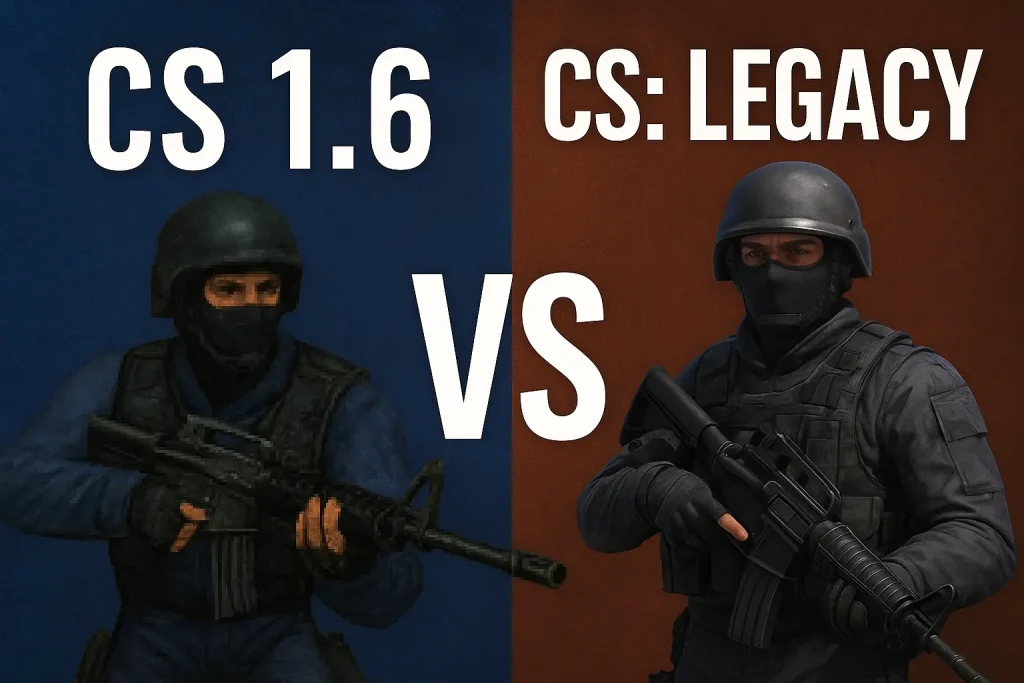
CS Legacy vs CS 1.6 is the comparison most fans of the original game want to understand. CS Legacy is a fan-made standalone remake of Counter-Strike 1.6 built on the 2013 Source Engine SDK by the team behind CSPromod. Announced in March 2025, it aimed to recreate the exact feel of CS 1.6 with modern visuals – same movement, same recoil patterns, same map layouts, but with PBR lighting, high-resolution textures, and updated audio. This page covers where the CS Legacy project stands now and how it differs from the original CS 1.6 across every major gameplay system.
Table of Contents
- CS Legacy current status – is it cancelled?
- Engine differences – GoldSrc vs Source 2013
- Movement and physics
- Recoil and weapon handling
- Economy and buy menu
- Graphics and visuals
- Maps
- Audio
- Server browser and online play
- Which one to play right now
CS Legacy current status – is it cancelled?
CS Legacy development is currently frozen. The project is not officially cancelled but has no active development and no confirmed path to release. Here is the full timeline:
| Date | Event |
|---|---|
| March 2025 | CS Legacy officially announced. Built on Source SDK 2013 with fully original assets – no Valve textures, models or sounds. Free-to-play, planned Steam Early Access in late 2025. |
| May 2025 | Valve issues cease and desist to Classic Offensive – a different CS 1.6 fan remake – shutting it down after 8 years of development. CS Legacy community grows concerned. |
| July 2025 | CS Legacy team receives a message from a Valve employee stating use of the Counter-Strike IP “might no longer be allowed without a separate, dedicated license.” Valve does not respond to follow-up emails. |
| August 2025 | Team refunds all Patreon backers. Begins parallel development of a new original IP on the Godot engine – no Valve code, no Counter-Strike branding. |
| January 2026 | Team officially announces CS Legacy development is frozen. States they will make “one last attempt” to contact Valve. If no response, they commit fully to the Godot-based IP. |
| Current | No response from Valve reported. CS Legacy remains frozen. Godot-based spiritual successor in active development. |
The CS Legacy team argued their project was fully within Valve’s Source SDK license and Steamworks guidelines. Valve never provided an official written response. The situation mirrors Classic Offensive, which received Valve’s green light in 2017 and a cease and desist in 2025.
The new Godot-based game carries no Counter-Strike IP – different map names, different faction names, original assets. The core gameplay philosophy remains: GoldSrc-style movement, deterministic recoil, fast TTK tactical gameplay.
Engine differences – GoldSrc vs Source 2013
The most fundamental difference between CS Legacy and CS 1.6 is the engine. CS 1.6 runs on GoldSrc – a heavily modified Quake engine from 1998. CS Legacy was built on Valve’s Source SDK 2013, with significant rewrites to the renderer, physics, and netcode to approximate GoldSrc behavior.
| Feature | CS 1.6 (GoldSrc) | CS Legacy (Source 2013) |
|---|---|---|
| Engine | GoldSrc – derived from Quake engine, 1998 | Source SDK 2013 – heavily rewritten by CS Legacy team |
| Renderer | Software, Direct3D, OpenGL | PBR shaders, modern OpenGL |
| Physics model | Low friction, floaty air control, exploitable momentum | More grounded by default, rewritten to approximate GoldSrc |
| Max FPS | Capped at 100 by default, uncapped via fps_max | Uncapped, 144Hz+ monitors supported natively |
| Netcode | Protocol 47/48, cl_updaterate/cl_cmdrate | Source networking rewritten for lower latency |
| Max players | 32 | 32 |
| Mod/plugin support | AMXX, MetaMod, 25 years of plugin ecosystem | Not established – project frozen before release |
The fundamental challenge was that Source engine physics are inherently more grounded and realistic than GoldSrc. The CS Legacy team rewrote collision detection, air acceleration, and player momentum systems from scratch specifically to match CS 1.6 behavior rather than standard Source behavior. They also rewrote large portions of the renderer to add PBR support while keeping the lighting behavior predictable for competitive play – standard Source lighting produces inconsistent shadows that can obscure enemies in corners, which would have been unacceptable for a competitive CS remake.
Movement and physics
Movement is the area where CS Legacy vs CS 1.6 diverges most. CS 1.6’s movement is built on GoldSrc physics quirks that became core competitive mechanics over 25 years. The CS Legacy team rewrote Source’s physics specifically to replicate them – but the project was frozen before any public release confirmed whether they succeeded.
| Mechanic | CS 1.6 | CS Legacy (intended) |
|---|---|---|
| Bunnyhopping | Chaining jumps while air-strafing builds speed beyond normal run speed. Requires precise timing. Core high-level movement skill. | Explicitly replicated – developers stated bhopping was a top priority |
| Air strafing | High air acceleration allows sharp directional changes mid-air – the source of CS 1.6’s “floaty” feel | Rewritten to approximate GoldSrc air acceleration values |
| Crouch-strafing | Crouching while strafing gives full accuracy bonus – fast repositioning while maintaining shot precision | Intended to be replicated |
| Duck-jumping | Jumping while crouching gives extra height – used to reach positions unreachable by normal jumping | Intended to be replicated |
| Player boost | Players can stack reliably – simple collision boxes allow consistent boosts to elevated positions | Source collision is more complex – team was rewriting to match 1.6 |
| Ladder physics | Distinct GoldSrc snap-to-ladder behavior, specific strafe-off speeds | Significantly different in Source by default – required custom rewrite |
| Wallbanging | Shooting through thin walls and doors – engine feature that adds strategic depth | Intended to be replicated with equivalent penetration values |
No Source engine project has ever fully replicated GoldSrc movement feel to the satisfaction of experienced CS 1.6 players. CSPromod – the same team’s earlier project – came closest of any attempt before CS Legacy.
Recoil and weapon handling
CS 1.6 recoil is fully deterministic. Every weapon has a fixed spray pattern that never changes. With enough practice the pattern can be completely memorized and counteracted – there is no random element. Every missed spray is a player error, not RNG. CS Legacy explicitly aimed to replicate this system identically.
| Weapon | CS 1.6 recoil | CS Legacy (intended) |
|---|---|---|
| AK-47 | Vertical rise then rightward drift – fully predictable, heavy first-shot accuracy | Identical pattern replicated |
| M4A1 | Vertical rise with slight left drift – tighter than AK, silencer reduces sound signature | Identical pattern replicated |
| AWP | One-shot kill to chest and above, scope sway, bolt-action cycle between shots | Identical behavior replicated |
| AUG / SG-552 | Scoped rifles with lower recoil than non-scoped equivalents | Identical behavior replicated |
| First-shot accuracy | Standing still, first shot 100% accurate for most rifles | Replicated |
| Movement accuracy penalty | Moving while shooting immediately reduces accuracy – players must stop before firing | Replicated |
The replication question goes beyond matching numbers. The GoldSrc engine’s visual feedback during spraying – minimal view punch, minimal muzzle flash, clean sightlines throughout a spray – contributes to how recoil control feels. Whether Source can replicate that tactile feedback alongside the numeric pattern was untested at public scale.
Economy and buy menu
CS 1.6’s economy is simple and well-understood: win money for kills and round wins, lose money for round losses, buy weapons and equipment at the start of each round. CS Legacy intended to replicate the CS 1.6 economy identically – same starting money, same kill rewards, same weapon prices, same equipment costs.
| Feature | CS 1.6 | CS Legacy (intended) |
|---|---|---|
| Starting money | $800 | Identical |
| Kill reward – rifle | $300 | Identical |
| Kill reward – AWP | $100 (reduced to discourage AWP camping) | Identical |
| Kill reward – knife | $1500 | Identical |
| Hostage rescue reward | $150 per hostage rescued | Identical |
| Bomb plant reward | $800 | Identical |
| Loss bonus | Progressive – increases per consecutive loss | Identical |
| Buy menu | Text-based radial menu, keyboard navigation | Updated visual design, same purchase options |
| Weapon prices | AK-47 $2500, M4A1 $3100, AWP $4750 | Identical |
Graphics and visuals
| Feature | CS 1.6 | CS Legacy |
|---|---|---|
| Textures | Low resolution – 256×256 to 512×512. Instantly recognizable visual style. | High resolution PBR materials with normal maps, roughness and metallic channels |
| Lighting | Static lightmaps baked into maps. No dynamic lighting. Consistent across all hardware. | Dynamic lighting, real-time shadows, ambient occlusion |
| Player models | Low-poly – immediately readable silhouettes at any range | High-poly, detailed – enemy readability at range was a documented concern |
| Death animations | Static – body stays in death position | Physics-based ragdoll |
| Resolution support | Up to 1920×1080, widescreen via config | Native widescreen and ultrawide support |
| Hardware requirement | Any hardware after 2000. Integrated graphics sufficient. | Dedicated GPU recommended |
CS Legacy looks like a modern game. CS 1.6 looks like a 2003 game. For competitive CS 1.6 players the low-poly visual style is not a weakness – clean enemy silhouettes and consistent lighting make the game easier to read than visually complex modern titles.
Maps
CS Legacy planned to launch with five maps rebuilt entirely from scratch: de_dust2, de_nuke, de_train, de_poolday, and aim_map. Every competitive angle, timing, and sightline was preserved identically from the CS 1.6 originals. The visual rebuild was substantial – de_nuke received improved visibility on its multi-level layout which was historically one of the hardest maps to read in CS 1.6 due to lighting, and de_poolday received updated water physics using Source’s fluid simulation. All geometry was rebuilt with modern modeling tools and higher-resolution textures while keeping every boost position, peek angle, and grenade lineup intact.
CS 1.6 has the full original map pool plus 25 years of community-made maps available on active servers. The CS Legacy launch pool of five maps would have been extremely limited by comparison. Community mapping tools were planned post-launch but were never implemented before the freeze.
Audio
Audio is one of the most debated areas in any CS 1.6 remake attempt. The original GoldSrc weapon sounds are deeply embedded in the muscle memory of veteran players – the AK-47 fire sound, the AWP shot, the flashbang pop are instantly recognizable after 25 years. CS Legacy recorded all audio from scratch with no original Valve assets, aiming for sounds that feel familiar without being legally identical copies. Whether high-fidelity replacements can carry the same psychological impact as the originals is a question that was never resolved publicly.
| Feature | CS 1.6 | CS Legacy |
|---|---|---|
| Weapon sounds | Original GoldSrc audio – mono or basic stereo, immediately recognizable to any CS 1.6 player | Rerecorded high-fidelity audio designed to feel similar to originals – no Valve assets used |
| Footstep audio | Flat stereo – directional but imprecise at range. Experienced players read footstep timing rather than exact position. | 3D positional audio – precise directionality. Changes the information footsteps provide. |
| Bomb audio | Distinct beeping tick rate that experienced players use to estimate detonation timing | Replicated including tick timing |
| Flashbang effect | White screen with flat audio deafen – duration depends on angle and distance | Intended to replicate – Source flashbang system was rewritten |
| Radio commands | Classic voice lines unchanged since 2003 | New recordings – original voice actors not involved |
Server browser and online play
CS 1.6 uses Valve’s Steam MasterServer for server discovery – currently heavily polluted with fake servers showing 255/255 using A2S_INFO spoofing. Despite this, thousands of real servers run globally, particularly in Eastern Europe, South America, and Asia. The game has 25 years of server infrastructure development including AMXX plugins, ReHLDS, MetaMod, and extensive admin tooling. Server admins have full control over every gameplay variable through console commands and plugin systems.
CS Legacy planned to launch with its own private MasterServer with filtering applied from day one – no fake entries, no redirect traps. This was presented as one of the key advantages over Steam CS 1.6. However the server browser would have started from zero players with no established communities, no plugin ecosystem, no admin tools, and no history of populated servers. Growing a server population from scratch against 25 years of existing CS 1.6 infrastructure would have been the project’s biggest non-technical challenge.
Which one to play right now
CS Legacy is not available to play. No public build was ever released and development is frozen. The only scenario in which CS Legacy becomes playable is if Valve responds to the team’s final contact attempt and grants a path to release.
CS 1.6 is available now, has active servers globally, a complete map pool, 25 years of plugin support, and runs on any hardware. If you want to play what CS Legacy was trying to recreate, the original remains the only option. Download CS 1.6 and use external server lists like gametracker.ovh to find real servers without fake entries.
The Godot-based game the CS Legacy team is now building is a separate project with no Counter-Strike branding – different map names, different factions, original assets. No release date has been announced.
To obtain the stable version safely and also find more files on our Counter-Strike 1.6 site, feel free to use our links. To get started with the game today.