
Counter-Strike 1.6 Maps: Full List & All Map Types
Last updated: May 1, 2026
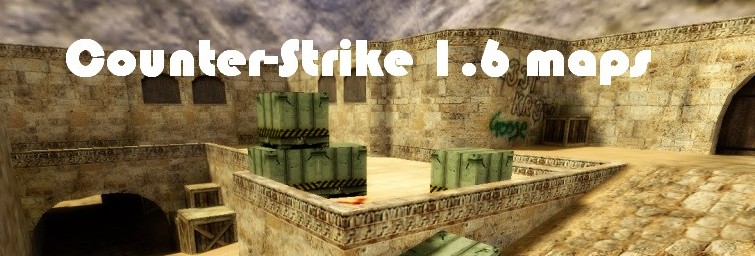
This is the complete Counter-Strike 1.6 maps reference — all default maps included with the game, every map type prefix explained with exact mechanics, CSS maps integrated into CS 1.6, and the most popular community-created custom maps. If you need the game first, download Counter-Strike 1.6 before joining any map servers.
- CS 1.6 Map Types Explained
- Default CS 1.6 Maps List
- Counter-Strike Source Maps in CS 1.6
- Popular Custom Maps
CS 1.6 Map Types and Prefixes Explained
Every CS 1.6 map uses a prefix that instructs the server which game rules to apply. These prefixes are not just naming conventions — they define spawn logic, win conditions, weapon availability, and health values. Understanding each prefix tells you exactly what gameplay mechanics to expect before loading the map.
Bomb/Defuse [de_]
The competitive standard and the core of professional Counter-Strike. de_ maps are built around the func_bomb_target entity and team-based economy. Terrorists plant the C4 bomb at one of two designated bomb sites, Counter-Terrorists defuse it before detonation.
These maps are designed with precise timing calculations. On de_dust2, the time it takes a Terrorist to reach Long A and a Counter-Terrorist to hold the same position is calculated down to the millisecond. One second of delay means full site control shifts to the opposing team. This creates the “default” setup where teams fight for map control before committing to a site push.
Because of the GoldSrc engine’s unique handling of brush geometry and wall thickness, de_ maps are famous for “wall-banging” — shooting through specific walls to kill enemies you cannot see. Map knowledge of exact hiding spots behind crates, doors, and corners is often more decisive than visual reaction speed. High-level play involves “pre-firing” these positions before rounding corners. de_dust2, de_inferno, de_nuke, and de_train are the most played competitive maps in CS 1.6 history.
Hostage Rescue [cs_]
The original game mode that launched the franchise. cs_ maps are built around the hostage_entity and reverse the role of aggression — Counter-Terrorists are the attackers who must infiltrate Terrorist-held positions.
Once a CT presses Use near a hostage, the NPC follows them to the extraction zone. Map geometry must account for hostage pathfinding: wider doorways, ramps instead of ladders, and clear paths to the rescue zone. Tight corridors and indoor combat dominate cs_ maps compared to the open bomb sites of de_ maps. cs_assault and cs_office remain among the most hosted maps on public servers, with cs_office appearing on 24/7 dedicated servers worldwide.
Aim [aim_]
Small, perfectly symmetrical arenas built for raw aim practice. aim_ maps eliminate all variables except crosshair placement and spray control — no objectives, no economy, no rotating. Weapons are placed in rows on the ground or distributed automatically at round start.
Map design prioritizes absolute minimum polygon count to achieve the highest possible FPS. Even a 1ms delay in a close-range duel can decide the outcome, so aim_ maps are built to remove all engine overhead. Common features include thin crates for headshot-only practice lanes and long straight corridors for tapping and burst-fire training. aim_ak-colt and aim_headshot are the most played aim maps in CS 1.6 history.
Fight Yard [fy_]
fy_ maps (fy_pool_day, fy_snow, fy_iceworld) eliminate the buy menu entirely. Weapons are scattered at spawn points — players pick up an AK-47 or M4A1 and start shooting immediately. No armor to save for, no grenades to buy, no economy decisions.
Layouts are extremely compact, making rounds last 20–30 seconds. This removes the economy layer of Counter-Strike completely and turns the game into pure gunfight practice. fy_ maps are the ideal bridge between competitive de_ play and raw aim training. fy_iceworld is one of the most played CS 1.6 maps of all time across all game modes combined.
Bunny Hop [bh_]
bh_ maps focus entirely on the air-strafe mechanic — a movement bug that became a core feature of CS 1.6. By jumping and moving the mouse in precise synchronization with the A and D movement keys, players bypass ground friction and accumulate velocity beyond the engine’s intended speed limit.
Maps consist of floating platforms, teleport triggers, and speed-boost pads. A single failed jump resets the player to the start of the section. The skill tested is rhythm and motor synchronization — the mouse movement arc must match the airborne trajectory exactly. Players who master bh_ mechanics can rotate between bomb sites faster than the engine allows through normal running, making it a genuine competitive advantage in de_ maps.
35hp (Knife Combat)
35hp maps enforce a server-side health override that changes the entire knife combat dynamic. In standard CS 1.6, a player has 100 hit points. A right-click knife stab (secondary attack) deals 65 damage — meaning two hits kill. A left-click slash deals less. At 35 HP, every single knife hit — including the weakest left-click slash — is an instant kill.
The tactical focus shifts entirely to “range baiting” — forcing the enemy to miss their swing, then moving in during their animation recovery window. Players use the “duck-run” technique and rapid direction-switching to manipulate their hitbox position. Maps are minimalist: narrow bridges, platforms over lava or water, where falling is as lethal as the opponent’s knife. This mode is the most direct training for close-quarters clinch situations in competitive play.
Knife Arena [ka_]
ka_ maps use full 100 HP — the strategic version of 35hp combat. Players must land multiple knife hits while protecting their back angle at all times, since a backstab in the GoldSrc engine deals critical damage regardless of remaining health.
The full health pool turns knife fights into battles of attrition and positioning rather than pure reflex. ka_ maps are more visually complex than 35hp arenas, featuring environmental hazards, traps, multi-level structures, and flanking routes. Strategic retreats and corner-control are viable here in a way 35hp never allows.
AWP [awp_]
awp_ maps are long sightline corridors that isolate the most powerful weapon in CS 1.6 into pure dueling conditions. Architecture creates defined lanes or window angles for sniper engagement, with a large no-man’s-land in the center that is impossible to cross on foot without being eliminated.
The core skill tested is counter-strafing — pressing the opposite movement key to stop instantly and achieve perfect accuracy before the opponent can react. AWP reload timing awareness is equally critical: players who know exactly when their opponent is cycling the bolt have a decisive window to push. awp_city and awp_india are the most played AWP maps in CS 1.6.
Death Run [dr_]
Death Run is a psychological asymmetric mode. One Terrorist player controls a room full of trap buttons, while all other players (CTs) are Runners navigating an obstacle course. The Terrorist never leaves their control room — the entire map is their weapon.
Traps include falling floors, crushing ceilings, spinning blades, instant-kill pits, and fake platforms that disappear on activation. Each trap is manually triggered by the Terrorist pressing a button. Runners must use erratic, unpredictable movement and deliberate fake jumps to bait the Terrorist into wasting trap activations on empty air. If a Runner reaches the end of the course, they typically access a weapon room for a final 1v1 showdown against the Terrorist.
Zombie Mod [zm_]
One player starts as a “Mother Zombie” with substantially increased HP and must infect humans by knifing them. Each infected human becomes a zombie. The human team must survive until the timer expires.
A well-designed zm_ map balances two competing requirements. It must provide defensible “camp” positions — vents, elevated platforms, narrow doorways — where a coordinated human team can hold indefinitely with knockback-heavy weapons. But it must also include multiple entry points and “boost” spots so that a coordinated zombie team can eventually break through. Lighting is critical: most zm_ maps use extreme darkness to force humans to manage limited flashlight battery while zombies have no such constraint. zm_ maps are among the most actively developed CS 1.6 community maps today.
Grenade War [he_]
he_ maps exploit the projectile physics and bounce logic of the GoldSrc engine. Players are separated by walls, wide gaps, or glass barriers that prevent all bullet-based combat. Everyone receives an infinite supply of HE grenades.
Victory requires mastering the exact arc of each throw and understanding how grenades bounce off angled surfaces — the angle of incidence equals the angle of reflection in the GoldSrc physics model. Landing a grenade precisely at the enemy’s feet behind a wall requires calculating multiple bounce points. he_ maps turn CS 1.6 into a tactical artillery simulator where geometric intuition replaces aim entirely.
Deathmatch [dm_]
dm_ maps remove round structure and respawn delay entirely. Players respawn instantly at random locations spread throughout the full map geometry. There is no win condition beyond kill count — no bomb, no hostages, no economy.
Layouts are circular or looping to ensure players never reach a dead end and are always within seconds of the next encounter. dm_ maps are the fastest way to learn a new map’s layout, practice spray patterns on moving targets, and warm up mechanics before a competitive session. The absence of round resets makes this the most time-efficient practice mode in CS 1.6.
Gun Game [gg_]
gg_ maps are built for weapon progression from worst to best. Every player starts with the Glock-18. Each kill advances them one weapon tier. The final tier is the knife — and a knife kill demotes the victim back one tier. First player to complete the full progression wins.
Map balance must account for players at drastically different power levels fighting simultaneously — an AWP player hunting someone with a P228 requires different sight lines than equal-weapon duels. gg_ maps are typically multi-level and vertical to create stealth opportunities for low-tier players hunting knife kills against high-tier opponents.
Hide and Seek [hns_]
hns_ is a movement-versus-coordination mode. Terrorists carry no weapons and cannot attack. Counter-Terrorists carry only knives. Terrorists must survive until the time limit expires; CTs must knife every Terrorist before time runs out.
hns_ maps are vertical movement playgrounds: ladders, drainage pipes, complex rooftop geometry, and long-jump gaps ranging from 230 to 250 units that require precise timing and speed to clear. Terrorists exploit CS 1.6 engine movement glitches — ducking mid-air, edge-sliding, strafe-jumping — to reach positions CTs cannot easily follow. CTs must coordinate to cut off escape routes and corner targets, since one Terrorist surviving the timer means a CT loss.
What Are the Default CS 1.6 Maps?
These are the official maps shipped with every Counter-Strike 1.6 installation. Valve created the original set for the 1999 release. This cs 1.6 default maps list covers every map included with the base game — they remain the foundation of competitive and casual servers worldwide.

| Map Name | Map Name | Map Name |
|---|---|---|
| cs_747 | cs_backalley | cs_havana |
| cs_italy | de_airstrip | de_aztec |
| de_cbble | de_chateau | de_dust |
| de_dust2 | de_inferno | de_nuke |
| de_piranesi | de_storm | de_survivor |
| de_torn | de_train | de_vertigo |
| as_oilrig | cs_assault | cs_estate |
| cs_militia | cs_office |
de_dust2 is the most played CS 1.6 map of all time. Its balanced three-lane layout — Long A, Mid, and B tunnels — gives both teams equal timing to every critical position. de_train’s vertical train geometry creates unique elevation-based angles found nowhere else in the default map pool. de_nuke’s underground lower tunnels section is the most complex default map layout in CS 1.6. For downloadable map packs, see the CS 1.6 maps download section.
Counter-Strike Source Maps Integrated into CS 1.6
These maps were originally built for Counter-Strike Source and later ported into CS 1.6 by the community. CSS maps brought higher-resolution textures, updated lighting, and revised layouts. Many CSS map variants became as popular as the original defaults on public servers.

| Map Name | Map Name | Map Name | Map Name | Map Name |
|---|---|---|---|---|
| css_vietnam2 | css_vietnam | css_trainwinter_go | css_train_go | css_train_winter |
| css_train2x2 | css_train | css_snow2 | css_snow | css_skybound |
| css_shorttrain | css_port | css_overpass | css_nuke_winter | css_nuke_rarea |
| css_nuke2x2 | css_nuke2 | css_nuke | css_miragewinter_go | css_mirage2x2_go |
| css_mirage_go | css_mirage | css_kabul2 | css_kabul | css_inferno2x2 |
| css_inferno | css_india2 | css_india_go | css_india | css_dust3 |
| css_dust2winter_go | css_dust2night_go | css_dust2_source | css_dust2_remake | css_dust2k_go |
| css_dust2x2_go | css_dust2_go | css_dust2 | css_dust | css_deagle |
| css_crane | css_cbble | css_cache2x2 | css_cache | css_bycastor2 |
| css_bycastor | css_bycadust | css_aztec | css_assault2 | css_assault |
Popular Custom CS 1.6 Maps
These community-created maps became server staples across CS 1.6 history. Many remain active on public servers today. The list below covers the most widely played across all map types — aim, fy, de variants, awp, and specialist modes.

| Map Name | Map Name | Map Name | Map Name | Map Name |
|---|---|---|---|---|
| fy_iceworld | fy_pool_day | 35hp_2 | aim_taliban | aim_headshot |
| aim_map | $1000$ | $2000$ | cs_mini_militia_v2 | fy_simpsons |
| $2000$ | cs_mini_militia_v2 | fy_simpsons | fy_snow3 | fy_new_pool_day2 |
| fy_new_pool_day | de_dust2_3x3 | de_dust2_2x2 | de_pf_dust2 | fy_poolparty |
| fy_snow | cs_paintball | aim_ak-colt | aim_map_usp | cs_deagle5 |
| aim_ak | cs_max | de_hell | de_silo | de_aztec_0 |
| awp_city | de_nuke_2006 | de_cpl_mill | de_cpl_strike | de_russka |
| de_mirage | de_westwood3 | de_prodigy32 | de_old_style_map | de_abaddon |
To grab the original download Counter-Strike 1.6 build here as well as take a look at our Counter-Strike 1.6 portal, feel free to use our links. Ready to jump into the action?